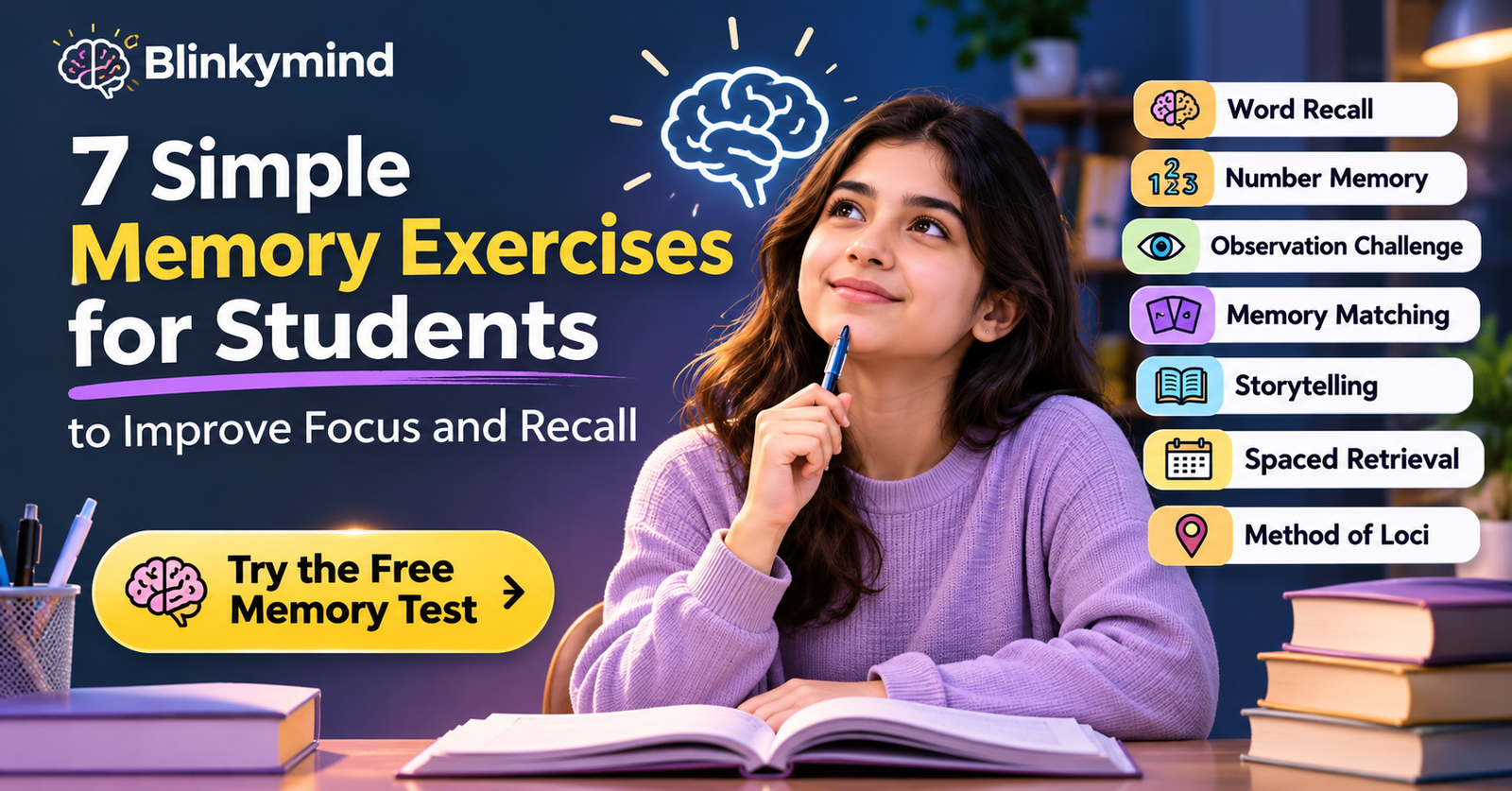
Memory exercises can help students practise concentration and recall. Simple daily activities offer opportunities to develop these skills. Memory exercises
Word Recall Exercise
Word recall helps students practise remembering information.
How to Practise
- Write five words.
- Read them for 30 seconds.
- Hide the words.
- Try to remember them.
Number Memory Exercise
Practise recalling a short sequence of numbers.
7 Simple Memory Exercises for Students to Improve Focus and Recall
Remembering information is an important part of student life. Whether you are preparing for an examination, learning a new language, or trying to remember classroom instructions, memory plays a role in everyday learning.
But remembering something is not always easy.
You might read a chapter several times and still struggle to recall its main points. You may remember an answer while studying but forget it during a test.
The good news is that memory is not simply about reading information repeatedly. How you practise recalling information also matters.
Simple memory exercises can help students develop useful learning habits, practise concentration, and become more familiar with different recall techniques.
In this guide, you will discover seven practical memory exercises that require little equipment and can fit into a daily study routine.
Quick Answer: What Are the Best Memory Exercises for Students?
Some useful memory exercises for students include word recall, number sequences, observation challenges, memory matching games, storytelling, spaced retrieval, and the Method of Loci.
These activities encourage students to pay attention, remember information, and retrieve it after a short delay.
No single exercise guarantees better memory in every situation. However, practising recall and using effective study techniques can make learning more active.
1. Word Recall Exercise
Word recall is one of the simplest memory activities for students.
It involves studying a short list of words and trying to remember them without looking.
How to Practise
1. Write down five unrelated words.
2. Read the words carefully for 30 seconds.
3. Cover the list.
4. Wait for one minute.
5. Write down as many words as you remember.
6. Compare your answers with the original list.
For example, try remembering these words:
Apple – River – Pencil – Mountain – Clock
After one minute, write down the words without looking.
Make It More Challenging
Start with five words.
When the activity becomes easier, try seven or ten words.
You can also increase the waiting period before recalling them.
Practical Tip: Try grouping related words or creating a short mental story to help remember them.
2. Number Memory Exercise
Number memory exercises involve remembering sequences of digits.
They are useful for practising attention and short-term recall.
How to Practise
Look at this number sequence:
4 – 8 – 2 – 7 – 1
Study it for ten seconds.
Now hide the sequence and try to write the numbers in the correct order.
If you remember all five digits, try a longer sequence.
Try Chunking
Instead of remembering a long number as individual digits, divide it into smaller groups.
For example:
583920
Can become:
583 – 920
This technique is called chunking.
Grouping information can make some sequences easier to remember.
3. Observation Memory Challenge
Observation exercises encourage students to pay attention to visual details.
This activity can be performed using everyday objects.
How to Practise
1. Place five small objects on a table.
2. Observe them for 30 seconds.
3. Cover the objects.
4. Write down everything you remember.
5. Check your answers.
You can use a pen, coin, key, notebook, and eraser.
Increase the Difficulty
After remembering the objects, try recalling:
Their colours
Their positions
Their approximate sizes
The order in which they were arranged
This exercise combines observation with visual recall.
4. Memory Matching Game
Memory matching is a familiar activity in which players try to find pairs of matching cards.
It can be played using physical cards or a digital game.
How to Play
1. Prepare six pairs of matching cards.
2. Shuffle the cards.
3. Place them face down.
4. Turn over two cards.
5. If they match, keep the pair.
6. If they do not match, turn them face down again.
7. Continue until you find all the pairs.
Why Try It?
The game requires players to remember previously seen cards and their positions.
It also provides an enjoyable way to practise visual attention.
Student Tip: Begin with six pairs and gradually increase the number of cards.
5. Storytelling Memory Exercise
Stories can help connect separate pieces of information.
Instead of memorising unrelated words individually, you can create a meaningful sequence.
How to Practise
Imagine you need to remember these words:
Book – Train – Garden – Moon – Bicycle
Create a short story:
A student carried a book onto a train. The train stopped near a garden, where a bicycle stood under the moon.
Now try recalling the five words.
Why Can Stories Help?
A story creates connections between individual items.
These connections can provide additional cues when you try to remember the information later.
You can use this approach for vocabulary lists, sequences, or simple classroom topics.
6. Spaced Retrieval Practice
Spaced retrieval is especially useful for studying.
Instead of repeatedly reading your notes, you practise remembering information at different times.
How to Practise
Suppose you are learning five science definitions.
Follow this simple routine:
Step 1: Read and understand the definitions.
Step 2: Close your notebook and try to recall them.
Step 3: Check your answers and correct mistakes.
Step 4: Review the definitions again later.
Step 5: Repeat the recall activity over the following days.
You might review the material:
After your initial study session
The next day
Three days later
One week later
These intervals are examples, not a fixed schedule for every student.
Why Is It Useful?
Retrieval practice encourages you to remember information without immediately looking at the answer.
Spacing study sessions also helps you revisit material over time rather than relying entirely on last-minute revision.
For academic learning, this is one of the most practical techniques in this guide.
7. Method of Loci Memory Exercise
The Method of Loci is a memory technique that uses familiar locations to organise information.
It is sometimes called the memory palace technique.
How to Practise
Imagine walking through your home.
Choose five familiar locations:
1. Front door
2. Living room
3. Kitchen
4. Bedroom
5. Study table
Now imagine placing one item you want to remember at each location.
For example, if you need to remember a shopping list, imagine a giant apple at the front door and a carton of milk on the living room sofa.
When you want to recall the items, mentally walk through the same locations.
When Can Students Use It?
The Method of Loci may be useful for remembering ordered lists, presentation points, or information that can be represented with memorable images.
It takes practice, and it may not suit every learning task.
How Often Should Students Practise Memory Exercises?
Students do not need to spend hours playing memory games.
A short daily session can be a convenient way to practise.
Here is an example routine:
Time Activity
2 minutes Word Recall
2 minutes Number Memory
2 minutes Observation Challenge
2 minutes Storytelling
2 minutes Review previous learning
Total: 10 minutes
This is a suggested practice routine, not a scientifically established minimum or an assurance of improvement.
For school subjects, combine these activities with understanding the material, retrieving answers from memory, and reviewing information over time.
Common Mistakes Students Should Avoid
Memory exercises are more useful when approached thoughtfully.
1. Only Rereading Information
Reading the same paragraph repeatedly may feel familiar, but familiarity is not the same as being able to recall it.
Try closing your book and explaining what you remember.
2. Practising Without Checking Answers
After attempting a recall exercise, compare your response with the correct information.
Feedback helps you identify mistakes.
3. Increasing Difficulty Too Quickly
Start with manageable exercises.
Gradually make them more challenging as you become comfortable.
4. Ignoring Sleep and Breaks
Learning is influenced by more than memory exercises.
Adequate sleep, appropriate breaks, and a sustainable study routine also matter.
5. Expecting Instant Results
Memory practice is not a shortcut to perfect recall.
Progress can vary depending on the task, the material, and the individual.
Try Blinkymind’s Free Memory Test
Want to explore your recall skills through an online activity?
Try the Blinkymind Memory Test.
It provides an opportunity to practise a memory-related task and observe your performance.
Try the Free Memory Test
Remember that an online memory activity is not a medical or psychological assessment.
Frequently Asked Questions
1. Can memory exercises help students study?
Memory exercises can provide opportunities to practise attention and recall. For academic learning, retrieval practice and spaced review are particularly useful strategies.
2. What is the easiest memory exercise for beginners?
Word recall is a simple starting point. Students can begin with five words and gradually increase the difficulty.
3. How long should students practise memory exercises?
A five- or ten-minute session can be a convenient starting point. The ideal amount depends on the activity and the student’s learning goals.
4. Are online memory games useful?
Online memory games can be enjoyable and provide practice on specific tasks. However, improvement in a game does not necessarily translate into broad improvements in intelligence or academic performance.
5. Which memory technique is useful for examinations?
Retrieval practice and spaced review are practical approaches for remembering studied material. Students can use flashcards, practice questions, or self-testing.
Final Thoughts
Improving study habits does not always require complicated techniques.
Simple activities such as word recall, observation challenges, and storytelling can make memory practice more engaging.
For remembering academic material, active retrieval and spaced review deserve particular attention.
Start with one exercise, practise regularly, and observe which methods help you learn.
Ready to practise? Explore the free Memory Test on Blinkymind and challenge yourself today.
Final Thoughts
Start with one simple memory exercise each day and track your progress.