How good is your memory?
Can you remember a list of ten words after reading it once? Can you recall a phone number without looking at your screen? Do you remember what you studied yesterday?
If you have ever wondered how to test your memory, you don’t need expensive equipment or a paid brain-training subscription to explore your recall skills.
With a smartphone, a notebook, and a few everyday objects, you can try several simple memory activities at home for free.
In this guide, we will explore five practical memory tests, a quick memory quiz, and ways to understand your performance without making misleading assumptions about your brain health.
How Can I Test My Memory at Home?
You can test your memory at home by trying activities that challenge your ability to remember words, numbers, images, and recently learned information.
Here are five affordable methods:
- Free online memory test
- Word recall test
- Short-term number memory test
- Visual memory test
- Delayed recall test
These activities explore different aspects of memory. They are suitable for informal practice and self-observation but are not medical diagnostic tests.
1. Take a Free Online Memory Test
Best for: People who want a quick and convenient memory activity.
Cost: Free.
Equipment: Smartphone or computer.
An online memory test is a convenient way to explore your recall skills without preparing physical materials.
Blinkymind offers a free memory activity that you can access through your browser.
How to Take the Test
- Open the Blinkymind Memory Test.
- Find a quiet place without distractions.
- Read the instructions carefully.
- Complete the memory challenge.
- Observe your performance.
Try the activity when you are comfortable and alert. Avoid writing down information unless the test instructions allow it.
2. Quick Memory Test: How Good Is Your Memory?
Best for: Practising word recall.
Cost: Free.
Equipment: Paper, pen, and a timer.
This simple memory quiz challenges your ability to remember a list of unrelated words.
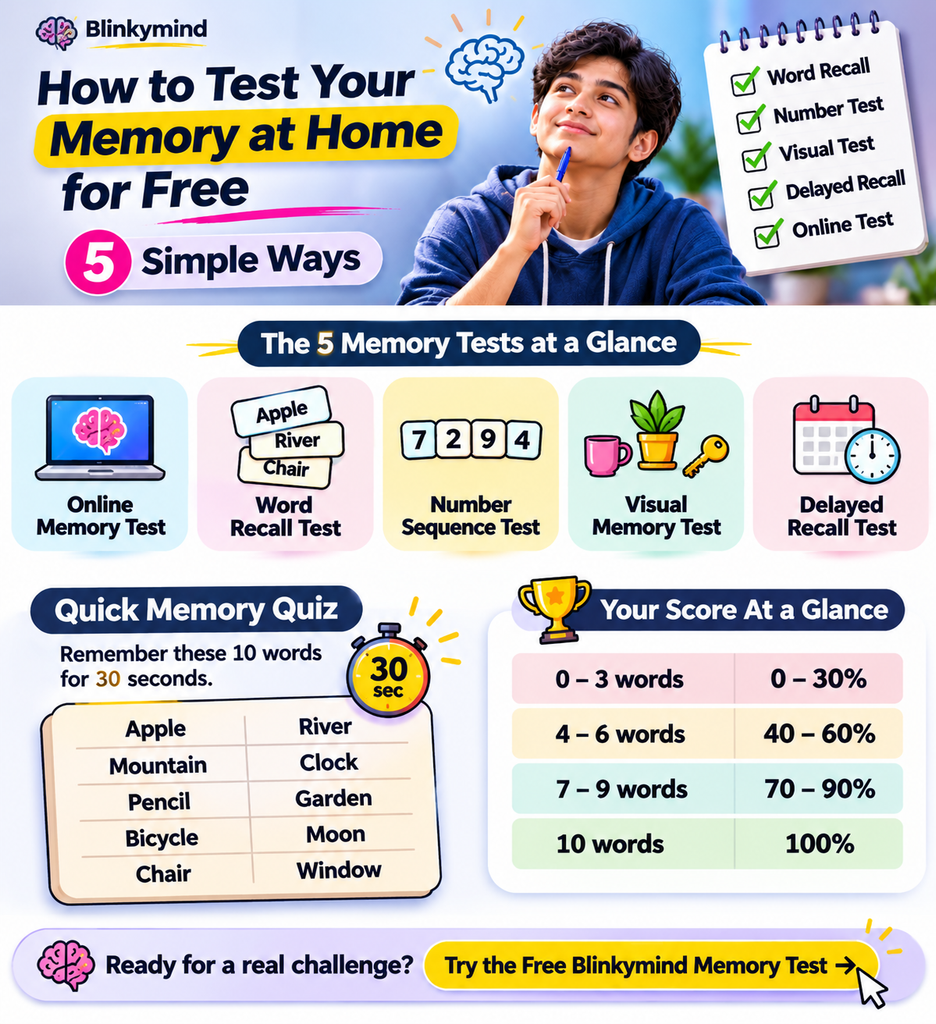
Step 1: Remember These 10 Words
Read the following words carefully for 30 seconds.
- Apple
- River
- Mountain
- Clock
- Pencil
- Garden
- Bicycle
- Moon
- Chair
- Window
Step 2: Hide the Words
Stop looking at the list and wait for one minute.
Step 3: Recall the Words
Write down as many words as you remember without checking the original list.
Step 4: Calculate Your Memory Quiz Score
Give yourself one point for each correct, unique word.
| Words Remembered | Task Score |
|---|---|
| 0–3 words | 0–30% |
| 4–6 words | 40–60% |
| 7–9 words | 70–90% |
| 10 words | 100% |
These percentages represent your performance on this particular activity. They do not classify your memory as poor, average, or excellent.
If you want to repeat the quiz, use a different list of words so that familiarity with the original list does not influence your results as much.
3. How to Test Your Short-Term Memory
Best for: Exploring immediate recall of number sequences.
Cost: Free.
Equipment: Paper and pen.
Short-term memory allows us to temporarily hold information, such as a phone number or a short instruction, in mind.
Try the following number memory challenge.
Level 1 — Five Digits
7 – 2 – 9 – 4 – 1
Study the sequence for ten seconds. Hide it and write the digits in the correct order.
Level 2 — Six Digits
5 – 8 – 3 – 9 – 2 – 6
Repeat the same process.
Level 3 — Eight Digits
8 – 1 – 7 – 4 – 9 – 2 – 6 – 3
Try remembering the entire sequence in the correct order.
Record the longest sequence you successfully recalled.
This is an informal number recall activity, not a standardised short-term memory assessment.
Try the Chunking Technique
Instead of remembering eight individual digits, divide them into smaller groups.
For example:
81749263 becomes 8174 – 9263.
Grouping information can make some number sequences easier to remember.
4. Visual Memory Test
Best for: Practising observation and visual recall.
Cost: Free.
Equipment: Everyday household objects.
Visual memory helps us remember objects, shapes, locations, and images.
Try a visual memory challenge using items already available at home.
How to Perform the Test
Place ten objects on a table. For example:
- Key
- Pen
- Coin
- Notebook
- Spoon
- Water bottle
- Eraser
- Watch
- Glasses
- Comb
Observe the objects for 30 seconds.
Cover them with a cloth and write down everything you remember.
Give yourself one point for each correct object.
Make the Test More Interesting
Ask a friend or family member to remove one object while you are looking away.
Try to identify which object is missing.
This activity can make visual recall practice more engaging without requiring you to buy a memory game.
5. Delayed Recall Memory Test
Best for: Students and people who want to explore how much information they remember after a break.
Cost: Free.
Equipment: A book, article, or notebook.
Delayed recall involves retrieving information after some time has passed.
How to Perform the Test
- Read a short paragraph about an unfamiliar topic.
- Identify five important points.
- Close the reading material.
- Spend ten minutes doing another activity.
- Write down the five points you remember.
- Compare your answers with the original information.
You can also attempt a similar recall activity the following day.
Students can use this approach to explore how much they remember from their study sessions.
Which Free Memory Test Should You Choose?
| Memory Test | What You Practise | Suggested Time | Cost |
|---|---|---|---|
| Online Memory Test | Interactive recall | Varies | Free |
| Word Recall Quiz | Verbal recall | 2–3 minutes | Free |
| Number Sequence | Immediate recall | 1–2 minutes | Free |
| Visual Memory | Observation and recall | 3–5 minutes | Free |
| Delayed Recall | Retaining studied information | 10–15 minutes | Free |
You do not need to complete every test in one session. Start with an activity that matches your interests and learning goals.
How to Know If You Have a Good Memory
Many people search for a memory quiz because they want to know whether they have a good memory.
However, memory is not a single ability that can be accurately measured through one short online activity.
You may be better at remembering faces than names, or better at recalling stories than numbers.
Different tasks involve different cognitive abilities.
Useful everyday memory abilities include:
- Remembering important instructions.
- Recalling recently learned information.
- Recognising familiar people and places.
- Remembering appointments and responsibilities.
- Applying previously learned knowledge when needed.
Occasional forgetfulness does not automatically mean you have a memory problem.
Rather than comparing your informal test score with someone else’s, observe your own performance over time under similar conditions.
How to Check Your Memory Power Over Time
You can maintain a simple memory practice journal to track your performance.
| Date | Activity | Score | Notes |
|---|---|---|---|
| Day 1 | Word Recall | 5/10 | Distracted |
| Day 3 | Word Recall | 6/10 | Quiet environment |
| Day 7 | Word Recall | 7/10 | Used a story technique |
The table above is an illustrative example, not a prediction of improvement.
Use fresh examples during each session and record relevant factors such as sleep, stress, and distractions.
An improvement in your score may reflect increased familiarity with the activity or a more effective recall strategy. It does not necessarily indicate an improvement in overall cognitive ability.
Do You Need to Pay for a Memory Test?
You do not need to purchase an expensive course, app, or brain-training subscription to begin practising memory activities.
Several affordable or completely free options are available:
- Free browser-based memory activities.
- Homemade flashcards.
- Playing cards and household objects.
- A simple notebook for recording scores.
- Free timers available on your smartphone.
- Self-testing using existing study materials.
Start with free resources before deciding whether a paid learning tool offers additional features you genuinely need.
Professional medical assessments are different from recreational memory activities and may involve healthcare costs.
How to Test Your Memory for Alzheimer’s and Dementia
Can an online memory test detect Alzheimer’s disease or dementia?
No. Informal home memory tests and online memory quizzes cannot diagnose Alzheimer’s disease, dementia, or other causes of memory difficulties.
A low score on a memory activity does not mean that you have dementia. Similarly, a high score cannot rule out a medical condition.
Memory performance may be influenced by several factors, including sleep, stress, medications, and health conditions.
Speak with a qualified healthcare professional if you experience:
- Persistent or worsening memory difficulties.
- Repeatedly forgetting important conversations or events.
- Difficulty completing familiar everyday tasks.
- Getting lost in familiar places.
- Memory changes that interfere with daily responsibilities.
A healthcare professional can determine whether further assessment is appropriate.
Sudden confusion or an abrupt change in memory or thinking requires urgent medical attention.
The memory activities provided in this article are intended for educational and recreational purposes only.
How to Practise and Improve Your Learning Habits
Checking your memory is only the beginning.
If your goal is to remember more of what you study or read, try incorporating effective learning strategies into your routine.
Useful approaches include:
- Active recall.
- Spaced review.
- Breaking information into smaller groups.
- Connecting new information with existing knowledge.
- Creating meaningful mental images and stories.
- Getting adequate sleep and taking appropriate study breaks.
Read our guide to 7 Simple Memory Exercises for Students to discover practical memory activities.
You can also learn How to Use the Method of Loci for Memory to explore a location-based memorisation technique.
Frequently Asked Questions
How can I test my memory for free?
You can try word recall, number sequences, visual memory challenges, delayed recall, or free online memory activities using your smartphone or computer.
How can I test my short-term memory?
Read a short sequence of numbers, hide it, and try to recall the digits in the correct order. Gradually try longer sequences using fresh examples.
How good is my memory quiz score?
Your score shows how well you performed on that particular quiz. An informal memory quiz cannot accurately measure your overall memory health or intelligence.
How do I test my brain memory every day?
Choose a short memory activity, use fresh examples, and record your performance. Keep the testing conditions reasonably consistent if you want to compare your results.
How do you know if you have a good memory?
Remembering recently learned information and completing everyday tasks reliably may reflect useful memory abilities. However, no single home quiz can establish whether your overall memory is good or poor.
How to know if you have photographic memory?
There is no widely accepted home test that can establish photographic memory. Remembering visual details accurately does not necessarily mean someone has photographic memory.
How to test someone’s memory at home?
With their consent, you can invite them to try word recall, number sequences, or visual observation activities. Do not use the results to diagnose a health condition or judge their intelligence.
How to test for memory loss?
If you are concerned about memory loss, discuss your symptoms with a healthcare professional. Home memory quizzes cannot determine the presence or cause of a medical memory problem.
Are memory tests useful for students?
Memory activities can help students explore recall strategies. For academic learning, active recall and spaced review are particularly useful approaches.
Final Thoughts
Learning how to test your memory at home does not have to be complicated or expensive.
Simple word recall quizzes, number challenges, and visual memory activities can provide an interesting way to explore your performance.
Choose a free activity, practise at your own pace, and focus on developing useful learning habits rather than chasing a perfect score.
Want to start right now?
Try the Free Blinkymind Memory Test
Challenge your recall, explore different memory activities, and make learning an enjoyable part of your everyday life.